
July 29, 2026 14:55 by
 Peter
PeterAs any ASP.NET application silverlight can connect to any of the web or data services like
- WebClient (simple HTTP request )
- WebRequest/WebResponse classes (to more complex HTTP requests )
- WCF Web Services (through proxy classes )
- ADO.NET Data Services
In this section we'll find how to create a WebClient in silverlight.
Using WebClient in Silverlight
In this article explain the step by step creation of a Web client application in Silverlight 2.0.
Create simple POX (Plain Old XML) Service
Step 1: Silverlight Application

- Create a new silverlight application WebClientAccessApp
- Add a new Class, called Employee.cs to the Web site part of your solution.
- Add member variables for EmployeeName, EmpID and Salary.
Step 2: XML Service
In this task you'll add a generic handler and have it return XML data back to the caller.
Add a new Generic handler to your Web application and call it EmployeeDataHandler.ashx
Create an instance of employee list 'empList' to which Employee object get added
The Generic handler will process an incoming request using the code declared in the ProcessRequest function.
In this function, some new instances of Employee are added into the empList.
Next, you'll write code that serializes the List<T> into XML and writes it back as a response to the caller. Here's the code:
XmlSerializer ser = new XmlSerializer(typeof(List<Employee>));
using (XmlWriter writer = XmlWriter.Create(context.Response.OutputStream))
{
context.Response.ContentType = "text/xml";
ser.Serialize(writer, empList);
}
You may notice that the ArrayOfEmployee node has been generated for you by the XmlWriter. It has also been given a default namespace and XSD.
Step3: XAML to bind
The XAML (Page.xaml)
- add a ListBox
- ItemsControl allows you to define how to render bound data according to a DataTemplate
- Add a single TextBlock that binds to the each property.
<ItemsControl x:Name="_employees">
<ItemsControl.ItemTemplate>
<DataTemplate>
<TextBlock FontSize="14" Height="30" Text="{Binding EmployeeName}" />
<TextBlock FontSize="14" Height="30" Text="{Binding EmpID}" />
<TextBlock FontSize="14" Height="30" Text="{Binding Salary}" />
</DataTemplate>
</ItemsControl.ItemTemplate>
</ItemsControl>
Step 4: WebClient
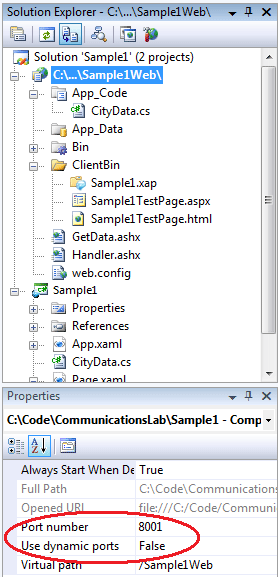
To set a static port for your Web project to run on,
- select the Web project in Solution Explorer, and press F4 to call up the properties window.
- 'Use Dynamic Ports' entry and set it to 'False'. Save everything
- then find the 'Port Number' setting and make it '8001'.
Step 5: In the client
In Page.xaml.cs
Call a POX Service
Add new code in Page() (constructor) that creates a new instance of the WebClient class, and then instructs it to download a string from the above URI, as well as wiring up a completed event handler callback.
public Page()
{
InitializeComponent();
WebClient wc = new WebClient();
wc.DownloadStringAsync(new Uri("http://localhost:8001/WebClientAccessApp/EmployeeDataHandler.ashx
"));
wc.DownloadStringCompleted += new
DownloadStringCompletedEventHandler(wc_DownloadStringCompleted);
}
Binding the Data on the Callback
When you specified the DownloadStringCompleted callback Visual Studio should have created a boiler plate event handler for you.
void wc_DownloadStringCompleted(object sender, DownloadStringCompletedEventArgs e)
{
}
The string data will be stored in DownloadStringCompletedEventArgs Result property, so you can load it into an XDocument using
XDocument xReturn = XDocument.Parse(e.Result);
One of the new language features in .NET, and in Silverlight is LINQ, which brings some functional programming to Silverlight.
So here's how you can use it to create an IEnumerable of Employee from the returned XML. As ItemsControl requires an IEnumerable to bind data
IEnumerable<Employee> employees = from employee in xReturn.Descendants("Employee")
select new Employee
{
EmployeeName = employee.Element("EmployeeName").Value,
EmpID = Convert.ToDouble(employee.Element("EmpID").Value),
Salary = Convert.ToDouble(employee.Element("Salary").Value)
};
To bind to ItemsControl set the ItemSource
_employees.ItemsSource = employees;
Here you are. After a long runyou have a result
You have seen some of these,
- WebClient which is used for simple asynchronous HTTP requests.
- XDocument, XmlWriter and XmlSerializer for managing XML Data
- The XML ItemsControl for data binding
For more complex HttpRequest, we'll find how in my following articles
Happy Coding.